The 13-Week Cash Flow Forecast: Find Your Low Week Before Year-End

Why Law Firms Stay Busy—but Struggle to Build Profit
May 1, 2026
What Is an EBITDA Bridge, and Who Should Explain It to You?
October 31, 2026A profitable $12M company can have $900,000 in the bank in late October and $350,000 the first week of January. Nothing went wrong. Every dollar that left was planned: the December tax payment, year-end bonuses, the insurance renewal, and four holiday weeks when customers pay slower. The P&L shows a good year. The bank account shows the low week. A 13-week cash flow forecast is how you see that week in October instead of finding it in January.
The number that matters is the low week, not the balance
Most owners check cash the same way: open the bank app, look at the balance, feel fine or not. The balance is a snapshot. It tells you nothing about the week four big bills land at once. The number I want every owner to know is the lowest cash balance in the next 13 weeks, and which week it falls in.
Thirteen weeks is one quarter. It is short enough that you can name every payroll date, every vendor run and every tax date with real accuracy, and long enough to see a problem while you still have time to act.
Why the low week hides from the P&L
The P&L is built to measure profit over a period. It spreads costs over the months they belong to. Cash does not work that way. Payroll leaves every week or two. Estimated taxes leave on four dates a year. Insurance often renews in one large payment. Bonuses are paid once. A year-end distribution to cover the owners’ taxes leaves in a single transfer.
Meanwhile, collections slow down in late December. Customers’ accounts payable teams take holidays too. So in the same four weeks that your biggest one-time payments go out, less cash comes in. The P&L for the quarter can look healthy while the bank balance drops by more than half.
That is why “we’re profitable, so we’re fine” is the most expensive sentence I hear in the fourth quarter. Profit is counted once a year. Payroll is counted every Friday.
The CFO math: a $12M company, week by week
Here is a worked example on round numbers. A company with $12M in annual revenue collects about $230,000 a week ($12M divided by 52). Its normal cash out, payroll, vendors, rent, software and debt payments, runs $220,000 a week. In a normal week, it adds $10,000 of cash. It starts the week of October 26 with $900,000.
- Weeks 1 to 7 (through early December): +$10,000 a week. Cash reaches $970,000.
- Week 8 (week of December 14): a $180,000 tax payment, and collections slow to $170,000. Cash falls $230,000, to $740,000.
- Week 9 (week of December 21): $150,000 of year-end bonuses. Cash falls $200,000, to $540,000.
- Week 10 (week of December 28): a $90,000 insurance renewal. Cash falls $140,000, to $400,000.
- Week 11 (week of January 4): collections still slow. Cash falls $50,000, to $350,000.
- Weeks 12 and 13: the $240,000 of late December collections arrives. Cash recovers to $480,000, then $610,000.
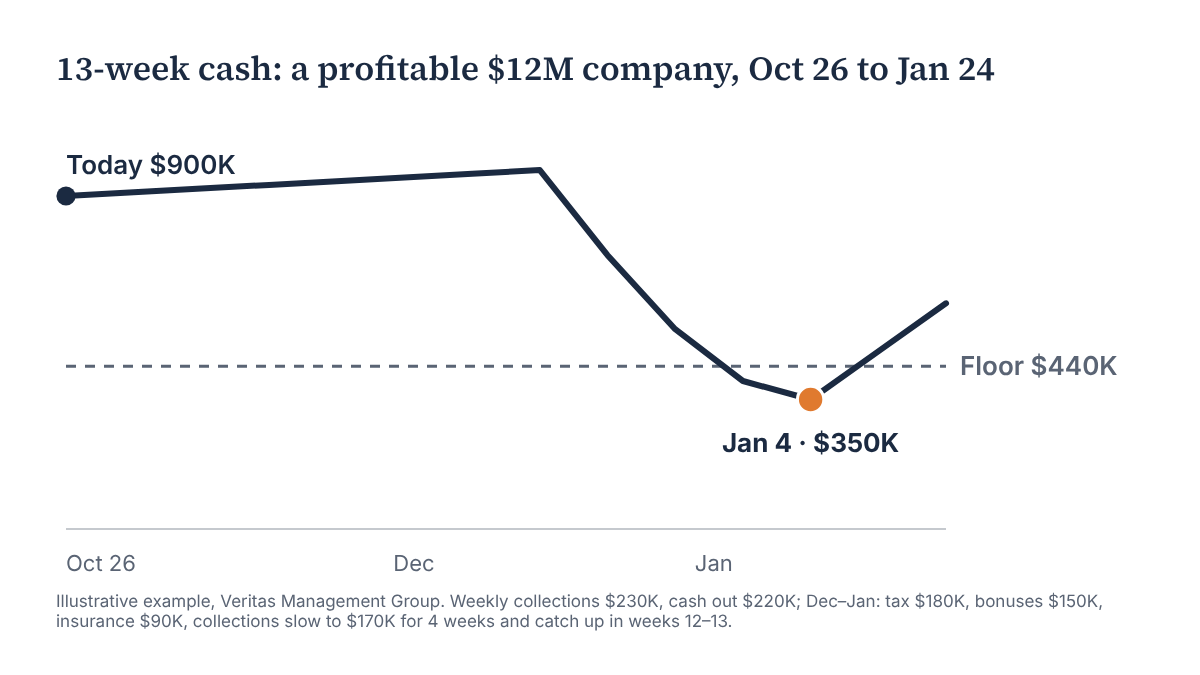
The low week is $350,000, the week of January 4. Four weeks moved $620,000 out of the account, and the company never lost money.
Is $350,000 a problem? It depends on the floor. My rule is simple: keep the low week above two weeks of normal cash out. Here that is 2 × $220,000 = $440,000. This company drops under its floor the week of December 28 and bottoms out $90,000 under it the week of January 4, before the late collections catch it up. Seen in October, that is a timing decision. Seen in January, it is a phone call to the bank asking for a favor.
Why this matters more this year: borrowing costs went up again
On September 16, 2026, the Federal Reserve raised its target range for the federal funds rate by a quarter point, to 3.75% to 4.00%. The prime rate, which most business lines of credit are priced from, moved to 7.00%. The Federal Reserve’s prime rate series on FRED shows how far that has come: 3.25% through 2021, 8.50% in 2023 and 2024, 6.75% for most of 2026, and up again in September. The Fed meets again October 27 and 28.
At prime plus 1, a line of credit costs 8.00% today. Drawing $100,000 for four weeks costs about $600 in interest ($100,000 × 8% × 28 ÷ 365). That is cheap insurance against a missed payroll. What is not cheap is asking for the line, or a bigger one, after the low week arrives. Banks lend on forecasts. A 13-week forecast that shows the dip, the cause and the recovery is exactly what a lender wants to see at renewal.
How to build your 13-week cash flow forecast this week
You do not need software to start. You need about two hours the first time, your real payment dates, and 20 minutes every Friday after that.
- Start with today’s bank balance, not the balance sheet cash line.
- Collections by the week you expect the cash, not the due date. Use what each customer actually does.
- Every cash-out date: payroll and payroll taxes, vendor runs, rent, loan payments, sales tax, estimated taxes, owner distributions.
- The one-time items for November through January: bonuses, insurance renewals, annual software, equipment deposits.
- Set the floor at two weeks of normal cash out and mark every week below it.
- Update it every Friday: replace last week’s forecast with actuals and add a new week 13.
What to do in November if your low week is under the floor
You have four levers, and in October and November you still have all four.
- Collect earlier. Call five days before invoices are due, again at 45 days, and escalate at 60. December invoices collected before December 15 are worth more than the same invoices in January.
- Move the timing of a one-time payment. Insurance on monthly terms, or bonuses paid after the late December collections arrive in mid-January, can close most of the gap. Talk to your CPA first about any tax effect of the timing.
- Size the distribution to the forecast. Owners’ tax distributions are real, but their size and date should come from the forecast, not habit.
- Arrange the line now. If the gap remains, ask your banker in November, with the forecast in hand, while the numbers still look strong.
The low week is one of three numbers I want every owner to have by the 10th of each month: the lowest cash week in the next 13, gross margin by job or service line, and the share of receivables over 60 days. If you can name all three, you are running the business on facts. If you cannot, that is the first thing to fix.
If you want to see your own low week, the Financial X-Ray builds your 13-week cash forecast from your bank and invoices, so you know your number before year-end.
Related: fractional CFO in Tulsa · outsourced controller in Tulsa · outsourced accounting in Tulsa · take the 3-minute Quick Score · cash forecasting best practices
See where your profit and cash actually go — in one hour.
The Financial X-Ray is a complimentary, one-hour read of your numbers by a fractional CFO (normally $5,000). You leave with three moves to make before year-end, in writing.
Book your complimentary Financial X-Ray