Cash Forecasting Best Practices for Growing Businesses: 7 Steps a Fractional CFO in Tulsa Uses
Is the Revenue You Booked Really Cash You Can Count On?
November 2, 2026Why Does My Month-End Close Take Until the 20th, and What Is It Costing Me?
November 3, 2026
Most owners of a $5M to $50M company can tell you what cash is in the bank this morning. Far fewer can tell you what it will be in six weeks. That gap is where missed payroll, surprise lines of credit and “why did we borrow that?” conversations come from.
J.P. Morgan’s Commercial Banking team published a short ebook on cash forecasting best practices for midsize businesses. It is a good checklist. Below is what it recommends, in plain English, and how we put it to work as a fractional CFO in Tulsa for owner-run companies.
Three words that get mixed up: position, flow, forecast
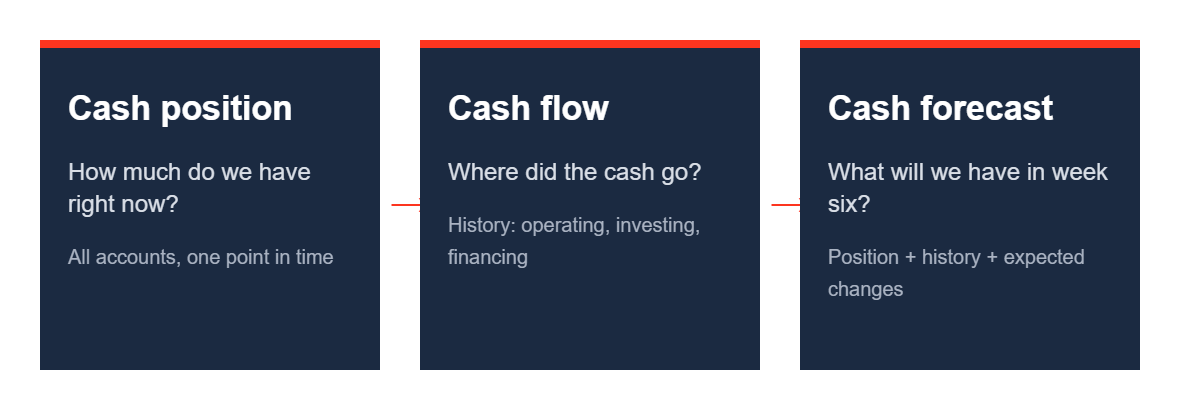
The ebook starts by separating three things owners tend to blur together:
- Cash position is how much cash you have right now, across every account.
- Cash flow is the history: where cash came from and went over a month, quarter or year.
- Cash forecasting is the forward view: your position at a point in the future, built from today’s position, your history and what you expect to change.
You cannot forecast without the first two. If the bank balance does not tie to the books and the close is late, the forecast is a guess with a spreadsheet around it. That is why a reliable month-end close comes before any forecast.
What accurate cash forecasting changes
The ebook names five areas: liquidity (knowing when you will be short or long), planning for big spends, spotting problems early enough to act, making strategic calls with confidence, and credibility with lenders and investors who ask for the forecast anyway.
The flip side is the list of what goes wrong without it: cash shortages and missed payments, loose collections, borrowing more than you need and paying interest on it, investing in projects that cannot carry themselves, a budget season built on hope, and strained relationships with vendors and the bank.
Every one of those shows up as a real dollar figure on the P&L or the balance sheet. Interest on a line you did not need is a cost. Receivables past 60 days are cash you earned and do not have.
The seven cash forecasting best practices, and what we do with each
| J.P. Morgan’s practice | How it looks in an owner-run company |
|---|---|
| 1. Use a rolling forecast, not a static one refreshed quarterly. | A 13-week forecast updated every week. Week one drops off, a new week comes on. It never goes stale. |
| 2. Pick a method and be ready to adjust: budget-based, driver-based, scenarios or a model. | Driver-based wins for most owners: sales volume, pricing, payment terms, payroll dates. Budgets feed it; they do not replace it. |
| 3. Segment cash into operating, investing and financing. | Operating cash tells you if the business works. Financing cash tells you if you are living on the line. Keep them separate on the page. |
| 4. Run multiple scenarios: best, worst, most likely. | Worst case is the one that matters: what if the two largest customers pay 30 days late? Find the low week before it finds you. |
| 5. Compare actual to forecast regularly. | Every week, one line: what we said, what happened, why. The “why” is where the forecast gets better. |
| 6. Document your assumptions, including seasonality. | Written assumptions on the forecast itself: collection days, growth, big dates. If it is not written, nobody can challenge it. |
| 7. Let technology do the heavy lifting. | Pull from the accounting system, not from memory. A forecast rebuilt by hand each week is the one that gets skipped. |
The practice that does the most work
If you only do one thing from that list, do number five. A forecast nobody checks against reality stays wrong in the same direction every month. The weekly variance review is where an owner learns that collections really run at 52 days, not the 30 on the invoice, and that the forecast should say so.
The second most valuable is the worst-case scenario. Growing companies rarely fail in an average week. They fail in the low week, usually when growth is strongest and receivables are stretched furthest.
Who owns the cash forecast
The ebook makes the point that the companies that do this well treat forecasting as a core competency, a muscle that needs exercise. In a $5M to $50M company that muscle usually belongs to an outsourced controller or a fractional CFO, not the owner. The owner’s job is to read it in ten minutes, see the low week and make the one decision it asks for.
That is the model we run: outsourced accounting in Tulsa that closes the books by the 10th, a 13-week forecast on top of it, and a CFO who turns it into decisions.
Free guides from Veritas
We turned these practices into a short owner’s guide with a weekly checklist and a one-page forecast layout you can copy, and we are sharing two of our books alongside it:
- Cash Forecasting for Growing Companies (PDF): the seven practices, the weekly checklist and the one-page 13-week layout.
- Beyond the Shop Floor (PDF): what every $5M to $50M manufacturer needs to know about cash, growth and what the business is really worth.
- The Financial Blind Spot (PDF): for attorneys and advisors of $5M to $50M companies, before the deal, the dispute or the exit.
Not sure where your company stands?
Take the three-minute Quick Score, or book a complimentary Financial X-Ray Review and we will show you your real profit and cash position, including your low week.
Source for the practices discussed: J.P. Morgan Commercial Banking, “Cash forecasting best practices for midsize businesses” (2025), summarized in our own words.
Related
- The 13-Week Cash Flow Forecast: Find Your Low Week Before Year-End
- Why Growing Businesses Still Struggle with Cash Flow
- Fractional CFO in Tulsa
- Outsourced controller in Tulsa
- Outsourced accounting in Tulsa
- Quick Score
See where your profit and cash actually go — in one hour.
The Financial X-Ray is a complimentary, one-hour read of your numbers by a fractional CFO (normally $5,000). You leave with three moves to make before year-end, in writing.
Book your complimentary Financial X-Ray